 For me, this was more than an exhibition.
It was a very personal moment.
The theme of identity has followed me for most of my life. I was born in Serbia, raised in Croatia, and shaped by the war in the former Yugoslavia. The country of my childhood disappeared from the map, but it never fully disappeared from my memory, my language, or my sense of self.
To be selected for an exhibition about identity in Seoul feels special because the work I am showing comes from exactly that place: the emotional space between belonging and not belonging, between memory and loss, between the person we are and the identity others place on us.
There is something powerful in this journey.
A work created in Hamburg, carrying the memory of a vanished country, travels to Seoul — to a city where tradition and modern life exist side by side, and where questions of identity, belonging and transformation can be felt in the rhythm of the place itself.
This exhibition gave one of my most personal works the chance to travel far away from where it was created — and still carry a story that many people, across cultures, may recognize.
Because identity is never only a passport, a language, or a place.
Sometimes identity is the wound left behind when all of those things become unstable.
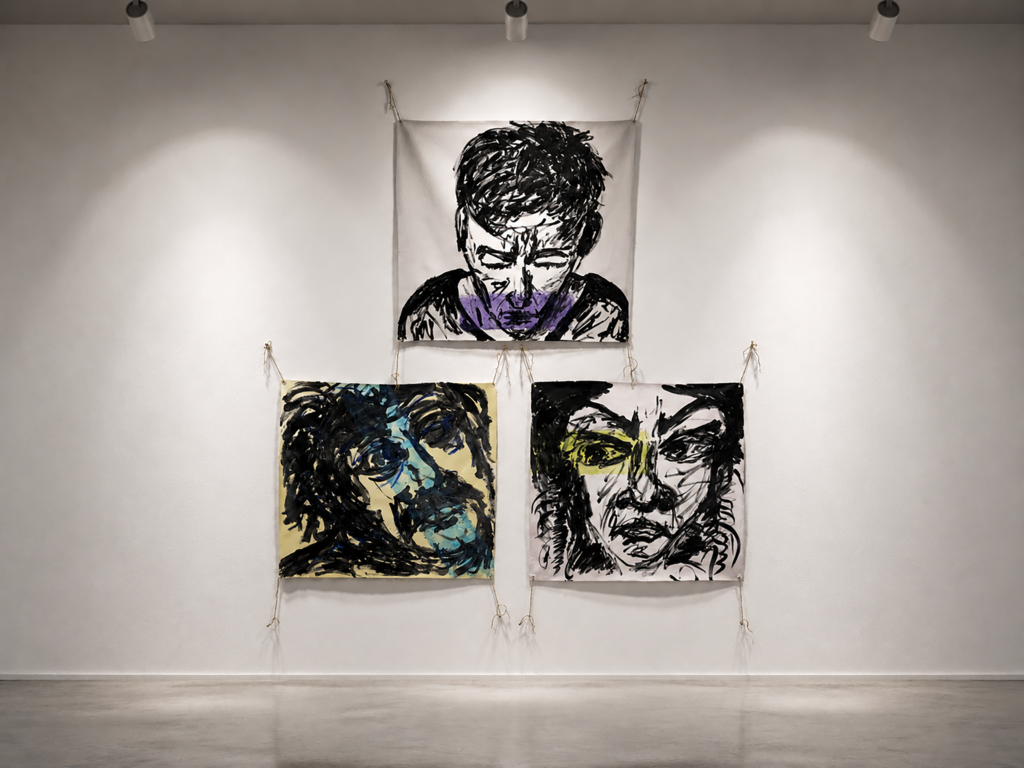 The work shown in Seoul is part of my series Faces Without a Country.
This series is deeply autobiographical. I did not paint imagined faces. I painted fragments of my own history, my memories, and the emotional consequences of losing a home that can no longer be returned to.
The series begins with the memory of Yugoslavia as home. It continues through exile, mistrust and the feeling of being permanently observed, named, classified or misunderstood. It arrives at shame — not guilt, but shame imposed from outside through history, society, language, accent, bureaucracy and the constant feeling of being different.
After many years of living in Germany, I still carry this conflict. My biography belongs to more than one place. My language carries traces of another world. My childhood belongs to a country that no longer exists.
The faces in this series are not meant to be beautiful.
They are meant to be true.
They show identity as something fragile, exposed and unfinished. Not as a clean answer, but as a condition. A life lived between presence and absence. Between continuing and giving up. Between being seen and being classified.
All works in the series are painted in acrylic on unstretched canvas. The loose canvas is important. It is not only a surface. It behaves like skin — vulnerable, marked, exposed and displaced.
Like identity itself, it is not fixed into a stable frame.
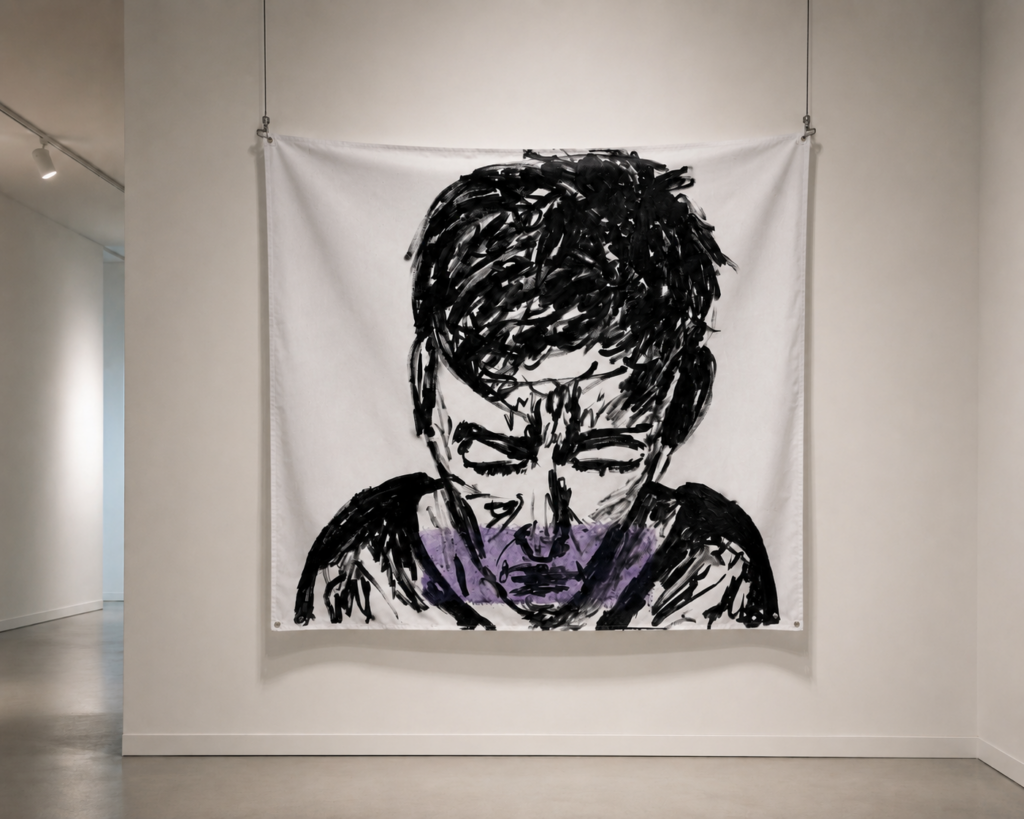 It is acrylic on unstretched canvas, 100 × 100 cm, and it is one of the most personal works from the series Faces Without a Country.
This face does not show guilt.
It shows shame that has been forced onto a person from outside.
The lowered head and avoided gaze suggest someone who has been made to feel wrong simply for existing in an unclear, unwanted or misunderstood category. The figure is not defeated, but withdrawn — as if it has learned that being seen can also mean being accused.
The violet-grey area across the lower face appears like a bruise, a stain or a second skin. It covers the area of the mouth and throat, turning language itself into a place of pressure and vulnerability.
For me, this is important.
Because accent, language and biography can become marks. Sometimes society does not only ask who you are. It decides what you are allowed to be.
The loose canvas reinforces this meaning. The work is intended to hang unstretched, suspended from its corners. It should remain visibly vulnerable, almost like exposed skin.
In this painting, shame becomes a mask.
Over time, the mask becomes skin.
And perhaps that is the most painful part of identity: not what we choose, but what the world teaches us to carry.